Istvan Szervatiusz, Restorer, Gilder

Nobody knows when that first moment in history was, when the first gold ingot was made of gold ore. Since when mankind realised the true features of this soft, yellow metal and mesmerised by it. Obviously first, solid statues were cast of it. Tools and technologies for manufacturing were yet too simple. The first mention about Gold Leaf like material is the Ark of Covenant, but there is a strong body of evidence that in Egypt the manufacturing of gold was as good as well.


The gold has special features indeed, not only being a noncorrosive metal, which feature is known by everyone.The gold is soft and ready to make alloys with other metals, which is very important in goldbeating and goldleaf. In our age the leaves are thin not as at the Ark of Covenant had been,possibly thick ,not so handy.


So what quality is important in our goldleaf ? Thickness, colour, how rigid, is what gives the quality of cutting. All comes with alloy, caratige and defines if the leaf is for watergilding or oilgilding. Can be easily burnished or not. In our world quite few firms are producing really good gold Leaf.


In 2002 I had the honour being invited to Yorkshire to estimate a job.To estimate and to give a restoration plan for an early Gillow sitting suit composed of several chairs,sofas and tabourettes. The family expressed their wish to use all of them in the future since Broughton Hall is not a museum. I made a search of layers which revealed 3 layers of chalk and glue gesso, painted, gilded, and 4 layers of oil based colours. The layers were loose. The final decision was that after a thorough documentation we return to the first scheme with the contemporan waterbased technology. The watergilding was partially burnished. The result was convincing so since then I’m permanent guest in the house. Later the stuccoes of the library and dining room were done by our team, and even later the White drawing room. One thing is important: when two small patches of gold turn up in a room, from then everything is changed there. The gold takes over, changes harmony of colours, changes distances, enhances previously irrelevant spots. In between two gilded spots, relevant ornaments become irrelevant. Tops of ornaments sparkle and everything near sinks in greyish-yellowish shadows. Sparkling tops attract gaze and block further eyemovements. These are the mysterious features of gold and gilders must take advantage of these.


It was hard to do all logistics of work which preceeds every major work scheme, pattern, technology, secure the site, tools, accesories like scaffoldins rythm of 12 hour size oil and 3 hours oil. Since this is a lived in house, we had to ponder the comfort of the family. The beautiful odour of 12 hours size oil might have not been enjoyed by everyone in the surroundings. The vulnerable, precious furniture and pictures seemed a bad idea to move out. Every moving is a risk. We decided to use only two small scaffoldings, and those to rotate around with the less movement of furniture as possible.


Lefranc oil and Wrights of Lymm gold was our choice, it worked out wonderfully.The neoreneissance mainly floral onaments came to life. Since those rooms are not overlit, light kills gold, and gold was a good couple of metres away from eyes, we decided not to detone anything. The result was convincing so the family decided that the white drawing room needed a major redecoration too, including cleaning all frames and furniture of the fireplace tar. Above the dado there was a heaviliy fake-gilded fillet of about 100 meters. Furniture and frames were repaired with bronze powder, fake gold and who knows what deep ocker paint. So we cleaned all and partially regilded. Now came the detoning of new gold until it’s nearly the same as old. And here comes the good alloy. How much rubbing endures the leaf. Our goal was to bring out the overlapping of leafs on frames and furnitue, exactly as the old surface.This took a short year. By then decorators rubbed all walls and designers designed the new wallpapers, curtains, carpets. Compared with this the gilding was a short 2 weeks action. Again using a Lefranc oil size and Wrights of Lymm’s Gold Leaf combo. The result was convincing again.


After this period I was busy restoring nice furniture and waiting for another massive gilding job around. This turned up when Roger Tempest of the family bought Aldourie castle near Inverness. Here came hundreds of frames again crowned at the end of the whole gilding project by the architectonical gilding in the castle itself. The castle was completely renewed and a nice article appeared in the 26,January Country Life in 2011.Our team is always busy with the Tempest family’s restoration projects since the Hall is in the state of permanent improvement room by room. This years ’little’ job was gilding 120 meters of heavily carved extremely moved fillets. Here came again the issue:to learn this special fillet to gild. How to cut ,rythm of 12 and 3 hours already reformed, lead acetate free oil. How to mop in goldmorsels to gain the most possible gold surface without laying a leaf.


At the beginning I mentioned that gold has special features. I got into trade, training in 1980, and in 1982 I layed up my first leaf. A little wrinkled, rugged but was my first. I was mesmerised, and I still am.

WRIGHT-IT SIGNWRITING GLOSS ENAMELS

Many Signwriters will remember the name J T Keeps as being one of the UK’s biggest manufacturers of Signwriting Paints until unfortunately there was a fire at their warehouse which eventually saw the business slip into liquidation. This was a sad loss to the Signwriting trade whom had enjoyed the old school colour range that had been so popular. After much thought and numerous enquiries from customers trying to get hold of the J T Keeps colours, Wrights of Lymm decided to join up with a UK paint manufacturer to replicate these so that the Signwriting trade could continue enjoying working with them. Now, over 10 years on and enjoyed by Signwriters and now Monumental Masons for the excellent characteristics, we have decided to try and replicate other popular colours within the Signwriting and Monumental Masonry trade at a fraction of the price, which of course saves you as the customer, money !!


The new colours in our range are Raven Black, Dove White, Mid Grey, Royal Blue, Mid Green, Pillar Box Red, Mid Brown and Yellow Chrome.


Our current popular range are White, Black, Holborn Cream, Gold Colour, Oxford Ochre, Holborn Brown, Golden Brown, French Blue, Azure Blue, Lemon Chrome, Poppy, Signwriters Red, Standard Red, Middle Chrome, Orange Chrome, Light Fast Green and Empire Green.


These paints are available in 250ml starting from £6.95 per tin. The paints can be thinned and brushes cleaned with white spirit. We currently have a special offer on at present that when you buy 8 colours you will receive 2 free.


Below you will see a good friend and customer of Wrights of Lymm for many years, Terry Colley using our Wright it Paints to renovate a Gypsy Wagon.

YOU CAN NEVER BE TOO YOUNG TO START GILDING!

A very special and important photo to one of our customers David Kynaston. His daughter Laura came into the workshop when she was just 5. David was finishing off a new swing sign for the Grosvenor museum in Chester, and said “ you know what to do Laura” and she picked up the gold (Wright’s of course!) and finished the job !!

watermark1-300x254


BOURLET FINE ART FRAMES, LONDON

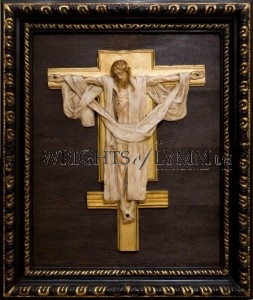
A valued customer of Wrights of Lymm, Bourlet Fine Art Frames have been making frames for over 200 years and remain a master reference for frame production and restoration in the art world today. Although the techniques and materials used in the frame making process have not changed since the early days, Bourlet has tweaked and adapted these techniques to the more progressive and modern demand requiring frames spanning from pre-raphaelite frame styles, to art-nouveau and more futuristic designs, thus seamlessly meeting the historical and esthetical qualities of the painting, print or photograph they contain. These qualities are not limited to the content they will be married to, since a client may approach Bourlet staff with preconcieved ideas and concepts they might prefer and one can be assured that the result will always be striking and more than satisfying.


Gabrielle Rendell and her wonderfully skilled staff have been working from the atelier on Connaught street for many years now and have proven many times over that the Bourlet framing business is still well and truly a source of customer satisfaction, with clients ranging from museums and national institutions to private clients. Any client with a desire to frame a beautiful or stylish picture can be sure that the Bourlet staff know-how and expertise will systematically shine through and demonstrate that the choice of frames at hand and the techniques employed will most certainly produce a remarkably fine balance and composite between the the finished frame and the painting, picture or etching contained within.


Here you can see some of their wonderful craftmanship using our Gold and Silver Leaf.


watermarkBourlet-4-225x300


A small tabernacle was gilded on to oak and the design was punched in. Each element of the frame was made separately and then assembled. It is a 19th century pre Raphaelite design.

watermarkBourlet-1-253x300


This frame was made for sculpture. A 17th century Spanish Design. This sort of parcel gilding is very fiddly and time consuming to do.

watermarkBourlet-2-300x264


Here Bourlet bought a poster of a Lowry and made a 3″ gilded frame, a gesso mount with a gilded bevel. The poster was put on board and varnished so that it resembled an original.

watermarkBourlet-31-225x300


A very blingy silver and black Spanish 17thc frame for a print.

RENOVATION OF ST ANDREWS CATHEDRAL, GLASGOW

The Gilders involved in this project were Scott Telfer, Stewart McLaren and Damian McLaughlin and they also had holiday cover from Ashley & Sarah Bishop and David Kynaston.


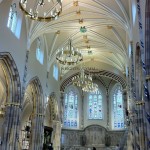
Scott, Stewart and Damian were asked to renovate St Andrews Cathedral in Glasgow, a building that dates back to 1814.

The building had been in a state of disrepair for a number of years and they literally had a blank canvas

to work from.  The interior fabric of the building is a plaster copy covering the original stonework. All decoration including the

faux stonework is Painted and Gilded.  Approximately 2300 books of 23.5ct Gold Leaf were used to create the effect spread over a timescale of 5 months.  The ceiling area and the top of pillars took about  2 months to complete. They then had to wait for other trades to finish their work and remove the top half of scaffold to complete the lower sections. There was a 3 month gap before they could get back to finish the project.


Another happy customer !!!


“A huge thanks to Clive and all the Staff at Wrights of Lymm for their help with this project, not only in supplying a great product

but having the knowledge to assist on any questions or queries we had”.


Barn Restoration

Wrights of Lymm received a call from Channel 4, asking if we could give our expert advice regarding gold leaf gilding for a program that is currently being filmed called “Barn Restoration”
Featuring the actor Simon O’Brien, as I am a Liverpudlian, I have always known him as the young Damien in Brookside.

The idea of the program is to search for items in an old barn and to refurbish for a profit. He found an old gold framed mirror which did need some tender loving care.

You can watch Simon gilding with gold leaf for the first time and the final outcome when the programme is aired on Channel 4 in January 2016

IMG_1256

Case Study – Richard Wright

Who can believe it’s over 5 years since Richard Wright won the 25th Turner Prize at Tate Gallery Britain in 2009 with a Decorative Wall using Genuine Gold Leaf from Wrights of Lymm.

Richard creates subtle and exquisite wall paintings that respond directly to the architecture in which they are created. Often awkwardly placed in discreet locations, they combine graphic imagery and intricate patterning from sources as varied as medieval painting, graphics and typography.

In the past years Richard has been in demand, creating magnificent artwork both privately and commercial. Although based in Scotland, Richard is currently working overseas.

Wrights of Lymm Ltd are extremely proud to work closely with Richard supplying all his Gilding and specialist products.

Keep up the good work Richard!!


watermarkturner-prize4